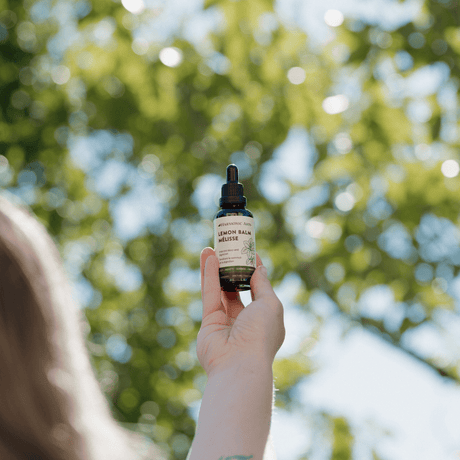
Every herb has a story. It begins in the soil, under sun and rain, tended by a farmer or gathered from a wild hillside. By the time it reaches your cupboard, that story has passed through many hands. The quality of what you hold depends on how carefully each of those hands did its part.
As a clinical herbalist, I've spent years learning to read that story. Two jars can carry the same herb's name and still be worlds apart. One holds a vibrant, living plant grown with care. The other may be faded, diluted, or harvested in a way that took more from the land than it gave back.
I believe the plants are a gift, and that caring for the earth is how we say thank you. Choosing quality herbs is one of the quietest, most everyday ways to honour that relationship. Here's what I look for, and what I hope you'll look for too.
Begin With the Soil: Organic and Wild-Harvested Herbs
The first thing I ask of any herbal product is simple: where did this plant grow, and how was it cared for? I look for herbs that are certified organic or responsibly wild-harvested.
Organic growing lets a plant develop without synthetic pesticides or herbicides, so what you take in is the plant and nothing more. Wild-harvested herbs grow just as nature intended, shaped by their surroundings into strong, complex medicine.
With wild herbs, the word "responsibly" matters deeply. A wild stand can take years to recover from careless harvesting, and some can disappear altogether. A thoughtful company will be glad to tell you how its wild herbs are gathered and how those places are protected for future seasons.
Know the Hands That Grew It
A herb's quality is tied to the people who grow and harvest it. When farmers are respected and fairly paid, they have the time and resources to grow with patience. That care shows up in the plant.
At Harmonic Arts, we build lasting relationships with our growers rather than chasing whatever is cheapest each season. Before we partner with a farmer, we carefully review their organic growing, harvesting, and processing practices to make sure they align with our standards for quality and ethics.
This is also why I'm a member of, and passionate advocate for the Sustainable Herbs Initiative. SHI works to bring transparency to the botanical supply chain and to support practices that protect plants, people, and the ecosystems we all depend on. I'm grateful to be part of a community asking how herbs can be sourced in a way that gives back.
When you're choosing a product, look for a brand that speaks openly about its growers, its sourcing regions, and its commitments to the land. If that information is hard to find, it's always worth asking.
Look for Third-Party Testing
Plants draw everything they need from the earth, water, and air around them. Along the way, they can also take up things we'd rather not bring into our bodies, like heavy metals or unwanted microbes. These can't be seen, smelled, or tasted, which is why testing is so important.
I look for products that have been tested by an independent, third-party lab. An outside lab has no stake in the outcome, so its results offer a clear, honest picture. For me, testing for heavy metals and microbial contamination is the foundation of trust between a herbal company and the people it serves.
A brand that tests well will usually say so, and will be happy to explain its process if you reach out.
Understand How It Was Extracted
Even the most beautifully grown herb can lose its strength if it isn't extracted with care. I always look at how a product was made and at its extraction ratio, because together they tell me how much of the plant's potency has been carried into the bottle.
For tinctures, the ratio describes how much herb was used compared to the liquid. A 1:2 tincture uses one part herb to two parts liquid, while a 1:5 uses one part herb to five parts liquid, so the 1:2 is more concentrated. Powdered extracts often show a ratio like 10:1, meaning ten parts of raw herb were used to make one part of finished extract.
There's no single perfect number, since each plant and preparation has its own needs. What matters most is openness. When a company shares its extraction ratios, it's inviting you to understand exactly what you're receiving. If you can't find a ratio anywhere, that's a gentle signal to ask a few more questions.
Keep It Pure: A Word on Fillers
I look for herbal products that are free of fillers, or that use only the smallest amount truly needed. Some fillers have a real purpose, like helping a fine powder move smoothly during bottling. Others simply take up space, so you receive less of the plant you were looking for.
In the spirit of transparency, I'll share our own approach at Harmonic Arts. Some of our powders contain 0.1% brown rice powder, because a tiny amount helps with bottling. It's a simple, whole-food ingredient used in the smallest quantity that does the job.
Not all fillers are so gentle. Some products contain large amounts of additives you would never choose to eat on their own. A good rule of thumb is to look for a short ingredient list with the herb at the top, and anything else clearly named and easy to understand.
A Closer Look at Medicinal Mushrooms
Mushrooms are a beautiful example of how much the details matter. When I'm choosing a mushroom product, the first thing I want to know is whether it was made from the fruiting body or from mycelium.
Fruiting Body or Mycelium?
The fruiting body is the part of the mushroom most of us picture, the cap and stem that rise from a log or the forest floor. Mycelium is the fine, root-like web that spreads quietly through wood and soil.
Fruiting bodies contain a considerably high variety and volume of bioactive compounds, including the polysaccharides that support human health. They've also been studied for a long time, and the depth of research behind them is substantial.
Most North American mushroom farms focus on growing mycelium, often on a sterilized grain substrate in a lab, where it's rarely exposed to the elements. Mycelium has its own benefits, but I prefer to work with the whole expression of the mushroom. That's why every Harmonic Arts mushroom powder is made from 100% fruiting body.
Why We Source Our Mushrooms From China
People are sometimes surprised to learn that we source our mushrooms from China. It's a choice we've made mindfully, with purity, potency, and quality at the heart of it.
China has one of the longest traditions of mushroom cultivation in the world, reaching back to Shiitake cultivation in the 13th century. Today, it's the leading producer of traditional log-grown mushrooms, accounting for over 85% of the world's supply. Over centuries of growing and use, Chinese medicine has developed rigorous standards for cultivating medicinal mushrooms, especially fruiting bodies.
Our mushrooms come from organic farms in the mountainous regions of China and from the birch forests of Siberia. These growers cultivate fruiting bodies on traditional mediums such as wood, which closely resembles a mushroom's wild home. Growing this way gives the mushroom the nourishment it needs to form a fruiting body rich in polysaccharides.
As with every grower we work with, we review each farm's organic growing, harvesting, and processing practices before beginning our partnership. To me, where a mushroom comes from matters less than how it was grown, and these traditional practices produce some of the finest mushrooms I've worked with.
Let Your Senses Guide You
Lab tests tell us what isn't in a product. Our senses help us understand what is. Even after all my years working with plants, I still rely on smell and taste every day, and I encourage you to do the same.
Well-grown, well-handled herbs feel alive. Their colour is rich, their aroma is clear and inviting, and their flavour has character. Herbs that smell dusty or flat, or that seem to have no taste at all, may be old, poorly stored, or over-processed.
You don't need any special training to begin. Simply slow down when you open a jar or steep a cup of tea. Breathe it in, notice the colour, and taste with curiosity. Over time, your senses will become one of the most trustworthy tools you have.
A Simple Checklist for Choosing Quality Herbs
The next time you're choosing an herbal product, take a quiet moment to ask:
- Is it certified organic or responsibly wild-harvested?
- Does the brand share who grows its herbs and how they're cared for?
- Has it been third-party tested for heavy metals and microbes?
- Is the extraction ratio listed?
- Is it free of fillers, or are any fillers minimal and clearly explained?
- If it's a mushroom product, is it made from 100% fruiting body?
- Does it smell and taste vibrant and alive?
Choosing Quality Is a Way of Giving Back
Every herbal product we choose is a small vote for a way of living with the earth. It supports a kind of farming, a way of treating the people who grow our plants, and a relationship with the wild places that sustain us. Mother Nature offers us so much nourishment. Protecting her in return is our responsibility, and choosing with care is one of the gentlest ways to honour that.
This Green Friday, we're putting that belief into action. Harmonic Arts will donate 1% of all profits from Green Friday to the Sustainable Herbs Initiative, supporting their work toward a more transparent and sustainable botanical supply chain. I hope you'll join us in celebrating the plants and the people who care for them.
With gratitude for the plants, and for you,
Angela Willard
Clinical Herbalist, CEO, and Co-founder of Harmonic Arts